- Startup Intros
- Posts
- Weekly Download #39
Weekly Download #39
The US Department of War tried to blacklist Anthropic. It backfired.

Dev Chandra
March 02, 2026 • Estimated Reading Time: 7 minutes

Hi !
This week in Silicon Valley, startups & tech:
Pentagon vs. Anthropic: Trump banned Anthropic from government use, then the military used Claude in an Iran airstrike hours later
OpenAI raised $110B at a $730B valuation: Making it more valuable than Goldman Sachs, Boeing, and GM combined; Amazon put in $50B alone
Block laid off 4,000+ people: It is the first major company to say the quiet part loud, being that AI automation is the reason
SpaceX is eyeing a $50B IPO this June at a $1.75T valuation: This would make it the largest public offering in history
MatX raised a $500M Series B: The Nvidia-challenger AI chip startup is backed by Jane Street & ex-OpenAI researcher Leopold Aschenbrenner
As we continue to build at Context Ventures, we've launched Startup Intros with a simple mission: to help early-stage founders find the right investors, faster and smarter.
🏛️ Anthropic vs The Pentagon: How It Escalated
The slow-burning standoff we covered earlier ignited into something much bigger this week. Here's what happened in roughly 72 hours.

💣 The Designation
War Secretary Pete Hegseth set a Friday deadline for Anthropic to drop its AI red lines, so when Anthropic refused, he designated it a "supply chain risk", effectively barring military contractors from using Claude. President Trump then blasted Anthropic on Truth Social as a "Radical Left AI company" and directed every federal agency to stop using its products. Claude hit #1 in the US App Store the same day that users apparently agreed.
⚡ OpenAI's Move
Within hours, OpenAI announced its own agreement with the Department of War, maintaining its own safety red lines while signing with DOD. In a remarkable twist, the US military reportedly used Claude in its attack on Iran, hours after Trump banned it from federal use.
🔥 The Backlash
Two coalitions of workers at Amazon, Google, Microsoft, and OpenAI publicly sided with Anthropic, demanding their employers refuse DOD's demands. The FT reported that Amazon, Google, and Microsoft staff were urging executives to adopt tough AI guardrails and to refuse any defense contracts that compromise safety. The crux of Anthropic's refusal: the Pentagon wanted Claude for mass domestic surveillance of Americans and fully autonomous weapons, which Anthropic called a firm line it could not cross.
What This Means: This isn't a procurement dispute. It's the first time the US government has tried to use contracting power to force an AI company to remove its safety guardrails. The government that claims to lead on AI just threatened to blacklist the lab most focused on safety. And the market responded by making it the #1 downloaded app in America.
🚀 Startup Intros is Going to Startup Grind!

Big news! Startup Intros is officially a Community Partner for the Startup Grind Conference this April!
5,000+ founders, investors & operators at the Fox Theatre in Redwood City, April 28-29. This year, we're planning our own Startup Intros happy hour, so stay tuned!
🎟️ Want a FREE ticket? Refer Us To Your Friends!
We just launched a referral program: Every person you refer to Startup Intros counts as one entry toward a free conference pass.
More referrals, better odds. Winner drawn March 31st!
Every tier gets more personal, every tier gets more valuable:
2 referrals: The Ultimate Startup Programs & Accelerators List
3 referrals: 5-minute video roast of your website or social media
5 referrals: 5-minute Loom pitch deck roast with investor-lens feedback
10 referrals: 50 investors list hand-picked for your startup
15 referrals: 15 minutes with me for fundraising advice or whatever you need
💰 OpenAI's $730B Round: What It Actually Means
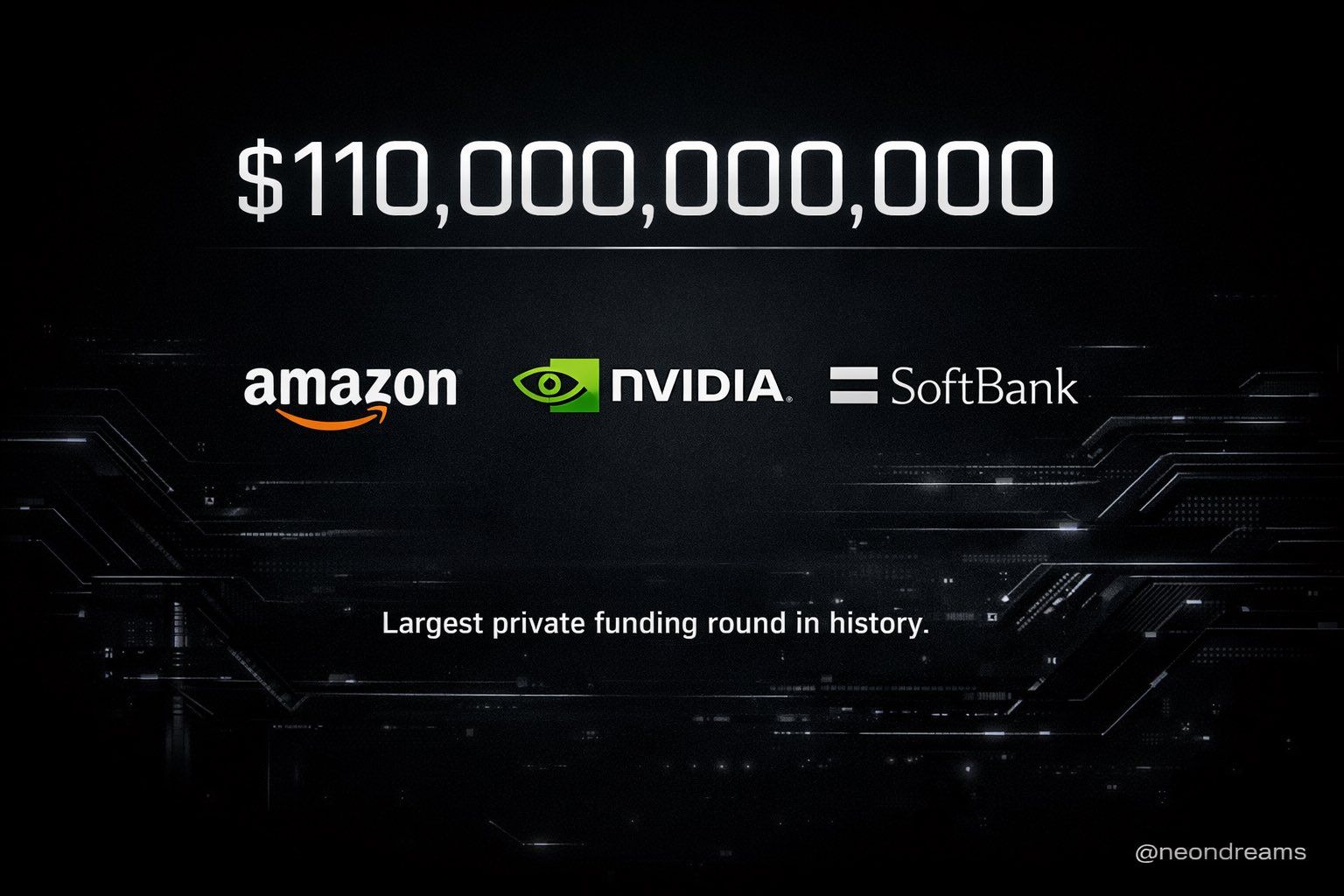
OpenAI closed the largest private funding round in history this week with $110B at a $730B pre-money valuation. The numbers are almost too large to be useful, so let's break down what actually matters.
📊 The Investment
Amazon invested $50B, Nvidia and SoftBank each put in $30B, with Amazon committing to roughly 2 GW of Trainium compute on AWS. OpenAI also plans to raise an additional $10B from financial investors by the end of March, pushing the implied valuation to $850B. Om Malik noted that Amazon is paying roughly 16x what Microsoft paid per percentage point of OpenAI ownership and getting none of their exclusives.
🎯 Who Invested and Why
This isn't a bet on OpenAI's current products; it’s a bet on AI infrastructure becoming the next internet, and a race to ensure you're not locked out of it:
Amazon's $50B: This cloud infrastructure play locks in OpenAI compute consumption on AWS while hedging against Azure's early-mover advantage.
Nvidia's $30B: Gives a loyalty investment in its biggest customer.
SoftBank's $30B: Masayoshi Son is doing what he does by betting the fund on the biggest technological shift of the generation.
Translation: OpenAI now has 900M+ weekly active users and 50M+ paying subscribers. The era of treating frontier AI as speculative is over. What comes next: intense pressure to go public, scrutiny of the $850B implied valuation against actual revenue, and a new benchmark for what any fundraise means in the AI era.
AI Is Eliminating More White-Collar Jobs
For two years, AI's impact on white-collar work has been underplayed as a theory, a trend line, a warning. This week, it really became a headline.
📉 The Block Signal
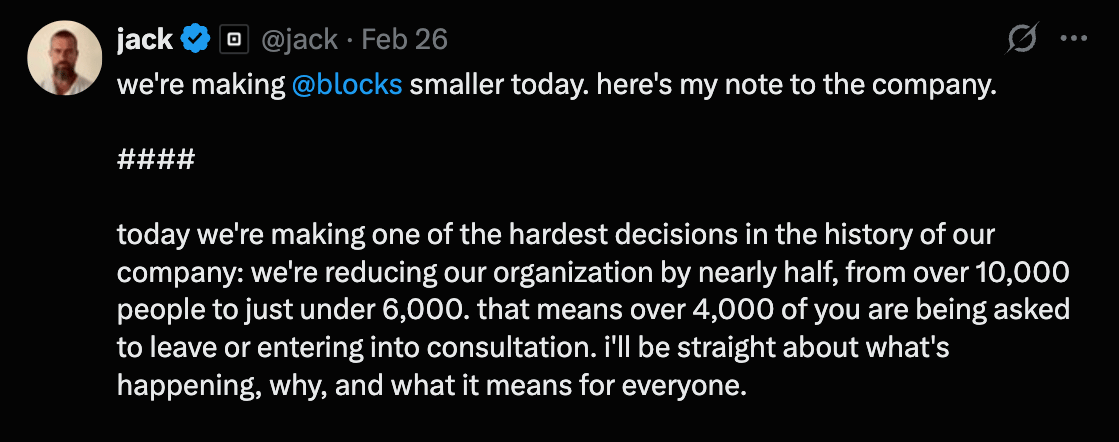
Block announced layoffs of 4,000+ employees, roughly 40% of its workforce, and explicitly cited AI automation as the primary driver. This is the first time a major public tech company has named AI as the central reason for mass layoffs. Bloomberg noted that the move has aroused suspicions of "AI-washing," the practice of blaming AI for cuts that would have happened anyway.
☁️ The AWS & India Outsourcing Signals
AWS engineers are being asked to take on new roles with the assistance of AI tools, with technical writing now required of engineers, which was a task traditionally handled by separate teams. Meanwhile, India's $300B outsourcing industry, which has never contracted in 24 years and employs over 6M people, is now facing what analysts describe as a structural, permanent disruption from AI automation.
🔬 What the Data Actually Says
Weirdly, a UCB study found that workers who use AI the most are actually working longer hours. The AI is increasing output expectations faster than it is reducing workload.
Translation: Block didn't lay off 4,000 people because of AI. It laid off 4,000 people because AI made it possible to justify it. That's the new normal.
🛸 Elon Says Space Will Be the Cheapest Place to Run AI in 36 Months

In a wide-ranging interview with Dwarkesh Patel and Stripe's John Collison, Elon Musk made a claim that sounds outlandish until you follow the logic: within 36 months, maybe 30, the most economically compelling place to run AI will be space.
⚡ The Power Problem on Earth
The bottleneck isn't compute; it's electricity. AI chip output is growing exponentially, so the global electricity output outside China is essentially flat. And the new data centers need to plug into a grid that can't keep up with these constraints:
Utilities move at the speed of regulatory approval.
Gas turbine blade manufacturing has a years-long backlog.
Solar tariffs make US domestic production uncompetitive.
The constraint isn't ambition; it's transformers and permits.
☀️ The Space Math of Solar
Solar panels in space receive roughly 5x more effective power than on the ground, as there is no atmosphere, no day-night cycle, no weather, and no batteries required. Factor out the battery cost, and the math puts space solar at roughly 10x the cost-effectiveness of ground solar.
Space-Solar Push: SpaceX and Tesla are building towards 100 GW per year of solar cell production. Space solar cells are also cheaper to manufacture, with no glass, no heavy framing, and no weatherproofing required.
🚀 What It Means for SpaceX (and the IPO)
SpaceX is simultaneously targeting a June IPO at a $1.75T valuation, which would be the largest public offering in history, while Elon Musk outlines a future in which SpaceX's launch infrastructure becomes the backbone of planetary-scale AI compute.
Translation: Elon isn't pitching space data centers as a moonshot. He's pitching them as the only place that can scale to meet exponential AI demand. Whether you believe the 36-month timeline or not, the energy constraint is real, and nobody else is talking about the solution he's proposing.
💰 Startup Quick Hits
MatX: $500M Series B led by Jane Street & Leopold Aschenbrenner's Situational Awareness fund for an Nvidia-challenger AI chip startup
Revel: $150M Series B for a unified software platform for hardware test and control, expanding into aerospace, defense, and robotics
Viture: $100M raised for an SF-based XR glasses maker led by Legend Capital, joined by Bertelsmann Group
Encord: $60M Series C led by Wellington Management for an AI-native data infrastructure for physical AI that grew to 5+ petabytes in 12 months
BreezeBio: $60M Series B (formerly GenEdit) for precision genetic medicines targeting diabetes and autoimmune conditions
Gambit Security: $61M Seed & Series A led by Spark Capital, Kleiner Perkins & Cyberstarts for an Israeli AI-native enterprise resilience platform
Humand: $66M Series A co-led by Kaszek & Goodwater Capital for an AI operating system for the world's 2.7B deskless workers
UpGuard: $75M Series C led by Springcoast Partners for cybersecurity and risk posture management
Rowspace: $50M Series A co-led by Sequoia & Emergence Capital for an AI platform for institutional financial data and decision-making
Guidde: $50M Series B led by PSG Equity for an AI platform for accelerating enterprise AI adoption
Flux: $37M Series B & Series A led by 8VC for an AI-powered PCB design for electronics
Temple: $54M at $190M valuation for a high-performance wearables for elite athletes, from Zomato's ex-CEO Deepinder Goyal
Paradigm: raising $1.5B new fund for expanding from crypto into AI, robotics, and frontier tech
🏦 Investor Funds Quick Hits
Peak XV: $1.3B raised across India Seed, India Venture, and APAC funds
Novacap: Closed Novacap Technologies Fund VII at nearly $3.8B
Second Sight Ventures: $75M debut fund led by Patrick Finnegan & Chris Hollod
📊 M&A / IPO & M&A Quick Hits:
Paramount acquires WBD: $31/share, $110B enterprise value; Netflix walked away first and collected a $2.8B termination fee
TMTG / Truth Social: in talks to spin off Truth Social into a standalone public company after completing the TAE nuclear fusion merger
Dell: Shares up 22% in a single session on AI server demand outlook: biggest single-day gain since March 2024
PayPay: SoftBank-owned payments app delays IPO roadshow amid market volatility tied to Iran strikes
🌟 Editor's Note
At Startup Intros, our mission is to bring the latest founder-investor news straight to your inbox, keeping you ahead in the fast-paced world of Silicon Valley.
💭 Parting Thoughts: This Week was about Boundaries
This week, the Pentagon escalated against Anthropic, and how it backfired in public opinion, OpenAI’s record $110B round at a $730B valuation, Block’s 4,000+ AI-driven layoffs as the first major company to say it out loud, and SpaceX potentially has a $1.75T IPO.
It closes with a packed list of funding rounds (including MatX’s $500M raise), major fundraises from Peak XV and Novacap, and M&A/IPO updates, such as PayPay’s delayed roadshow amid Iran-related market volatility.
Forward to a friend or hit reply to let me know what you're seeing in your world.
Till next time!
 | Dev Chandra |
P.S. Raised this week, and we missed you? Want to be featured? Have tips or funding questions? Reply or DM us as we’re here to help.
Startup Intros Weekly Download: Your trusted source for founder-investor insights, delivered with clarity and focus.